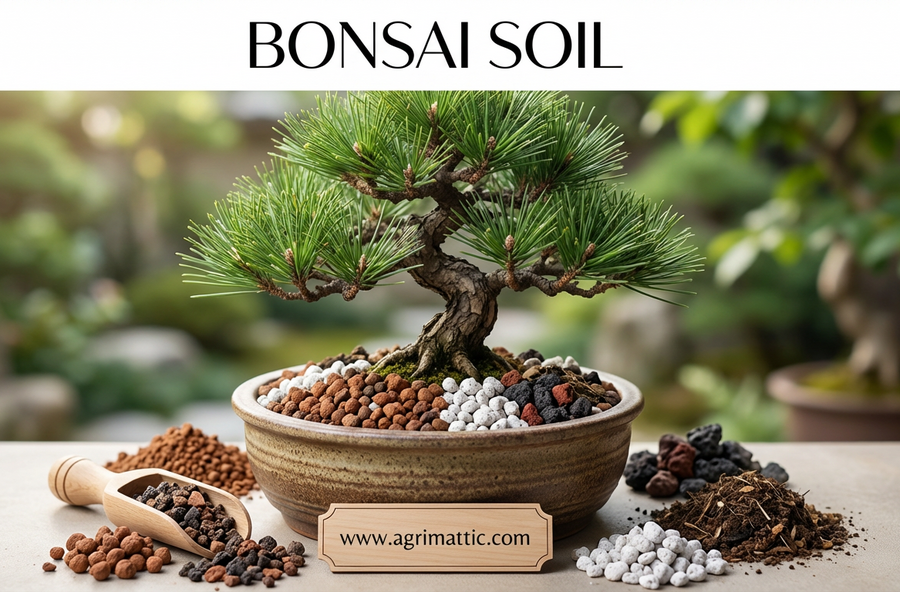
Bonsai Soil: A Complete Guide for Beginners
Introduction
If your bonsai tree isn’t thriving, the problem might be hiding in the soil. Many beginners are surprised to learn that bonsai soil looks nothing like regular potting soil – it looks more like a mixture of small rocks and pebbles.
This special soil solves critical problems that regular potting mix creates in shallow bonsai pots. Understanding what makes good bonsai soil will completely change how you care for your trees. Let’s explore why this “rocky” soil is actually the secret to healthy bonsai!
Why Regular Potting Soil Doesn’t Work for Bonsai
Before we talk about what bonsai soil is, let’s understand why you can’t just use regular potting soil from the garden center.
The Problem with Shallow Pots
Bonsai trees live in very shallow pots – often only 2-3 inches deep. Regular potting soil is designed for deep containers where gravity helps pull water down through the soil. In a shallow bonsai pot, that same soil creates serious problems.
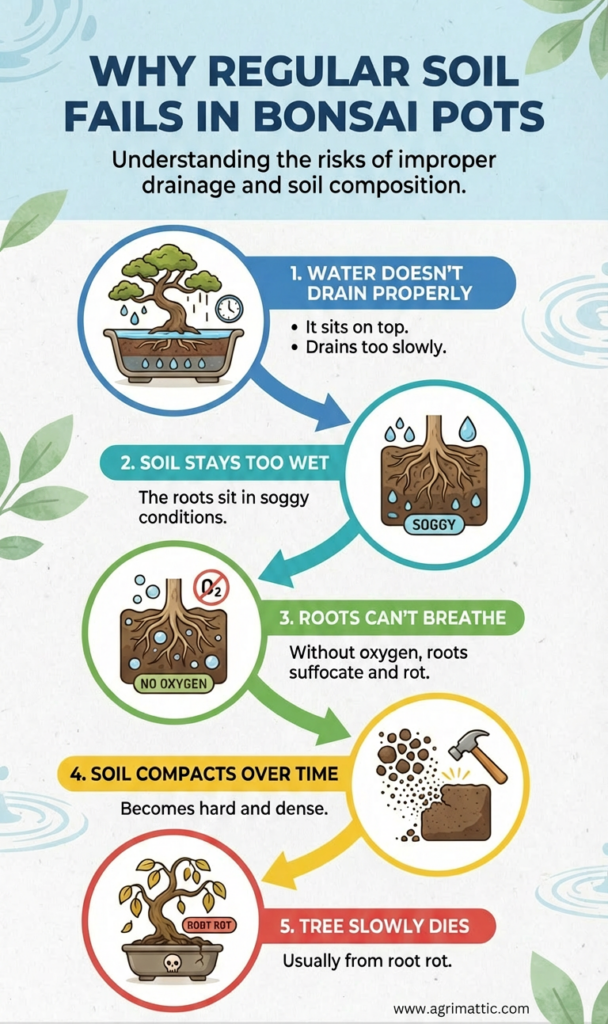
Why Regular Soil Fails in Bonsai Pots
- Water doesn’t drain properly – It sits on top or drains too slowly
- Soil stays too wet – The roots sit in soggy conditions
- Roots can’t breathe – Without oxygen, roots suffocate and rot
- Soil compacts over time – Becomes hard and dense
- Tree slowly dies – Usually from root rot
Think of it this way: Imagine trying to breathe underwater versus breathing fresh air. That’s the difference between roots in regular soil versus proper bonsai soil. Regular soil “drowns” the roots in a shallow pot.
What Regular Soil Looks Like vs. Bonsai Soil
Regular potting soil:
- Dark brown or black
- Fine texture, almost like dirt
- Contains peat, compost, and sometimes fertilizer
- Holds water like a sponge
- Compacts when wet
Bonsai soil:
- Various colors (brown, red, white, gray)
- Made of small particles (2-5mm in size)
- Looks like tiny rocks or gravel
- Water flows through quickly
- Doesn’t compact
The difference is dramatic, and it’s designed that way on purpose.
The Three Essential Properties of Good Bonsai Soil
Good bonsai soil must balance three things perfectly. Miss even one, and your tree will struggle.
1. Water Retention
Your soil needs to hold enough moisture for roots to drink between waterings. If soil drains too fast and holds no water, your tree will dry out and die.
Why it matters: Trees need constant access to moisture. Roots should never completely dry out.
What provides it: Components like akadama (clay particles) and organic matter that absorb water into their structure.
2. Drainage
Water must drain quickly through the soil, leaving no standing water. If water pools on top or the soil stays soggy, roots will rot.
Why it matters: Roots need both water AND air. Soggy soil has no air spaces, and roots suffocate.
What provides it: Hard particles like pumice and lava rock that create spaces between particles for water to flow through.
3. Aeration
The soil must have lots of tiny air pockets so roots can breathe. Roots use oxygen just like you do – without it, they die.
Why it matters: Roots can’t grow in compacted soil without oxygen. They need air spaces between particles.
What provides it: The structure of hard, irregularly-shaped particles that don’t compact and always leave gaps.
The magic formula: Good bonsai soil retains water WHILE draining quickly AND providing oxygen. It seems impossible, but the right mix of materials achieves all three.
Components of Bonsai Soil
Bonsai soil is a mix of different materials, each serving a specific purpose. Let’s look at the most common components.
Akadama (The Foundation)
What it is: A type of clay granule mined in Japan, fired at high temperatures.
Color: Orange-red to brown when dry, darker when wet.
Properties:
- Absorbs water into its porous structure
- Holds nutrients well
- Provides good aeration
- Breaks down after 2-3 years (which is why we repot)
Pros:
- Considered the “gold standard” in bonsai soil
- Perfect balance of water retention and drainage
- Traditional choice of Japanese masters
- Roots grow readily into it
Cons:
- Expensive (imported from Japan)
- Breaks down and needs replacing
- Quality varies between brands
- Hard to find in some areas
Substitutes: Calcined clay products (like Turface or Oil-Dri), fired clay cat litter (unscented, no additives)
Pumice (The Drainer)
What it is: Volcanic rock that’s been crushed and sifted to size.
Color: White, gray, or tan.
Properties:
- Very porous and lightweight
- Excellent drainage
- Holds some water in microscopic pores
- Never breaks down (lasts forever)
Pros:
- Provides great drainage
- Adds structural stability to mix
- Doesn’t decompose
- Lightweight
- Affordable
Cons:
- Holds less water than akadama
- Can float when watering if too light
- Dust can be irritating (wear mask when mixing)
Uses: Essential for trees that need excellent drainage (pines, junipers), good for all-purpose mixes.
Lava Rock (The Stabilizer)
What it is: Another volcanic rock, darker and often more angular than pumice.
Color: Red, brown, or black.
Properties:
- Very porous with lots of surface area
- Excellent for beneficial bacteria to colonize
- Provides great drainage and aeration
- Never breaks down
Pros:
- Creates excellent air pockets
- Very stable structure
- Good for root development
- Heavier than pumice (doesn’t float)
- Lasts forever
Cons:
- Holds less water than akadama
- Sharp edges can damage fine roots if pieces are too large
- Can be dusty
Uses: Great for conifers and trees wanting fast drainage, adds stability to any mix.
Organic Compost (The Nutrient Source)
What it is: Decomposed organic matter, usually composted bark or leaf mold.
Color: Dark brown to black.
Properties:
- Retains water well
- Provides some nutrients
- Encourages beneficial microorganisms
- Breaks down over time
Pros:
- Adds water retention
- Provides nutrients
- Improves soil biology
- Softens the mix for fine roots
Cons:
- Breaks down quickly (1-2 years)
- Can compact
- May contain weed seeds
- Can stay too wet
Uses: Usually only 10-20% of total mix, more for deciduous trees that like moisture, less for conifers.
Other Components You Might See
Pine bark: Shredded bark that retains moisture and adds organic matter.
Perlite: White volcanic glass that’s very light, good for drainage but can float.
Vermiculite: Expanded mineral that holds lots of water, used rarely in bonsai.
Sand: Coarse sand can improve drainage, but fine sand compacts – generally avoided.
Diatomaceous earth: Fossilized algae, similar properties to akadama.
Kanuma: Acidic volcanic soil, specifically for acid-loving plants like azaleas.
Basic Soil Mix Recipes
Different trees have different needs. Here are tried-and-true recipes for various situations.
All-Purpose Mix (Good for Most Trees)
This balanced mix works for 80% of bonsai trees:
- 50% Akadama (or akadama substitute)
- 25% Pumice
- 25% Lava rock
- Optional: Add 10% organic compost, reducing akadama to 40%
Best for: Maples, elms, most deciduous trees, junipers, pines
Why it works: Balances water retention with excellent drainage
Water-Loving Trees Mix
For trees that prefer more moisture:
- 60% Akadama
- 20% Pumice
- 10% Lava rock
- 10% Organic compost
Best for: Willows, bald cypress, bog plants, tropical trees
Why it works: Higher percentage of water-retaining materials
Fast-Draining Mix (Conifers)
For pines, junipers, and other trees that hate wet feet:
- 33% Akadama
- 33% Pumice
- 33% Lava rock
- 0% Organic matter (or maximum 5%)
Best for: Pines, junipers, spruce, other conifers
Why it works: Maximum drainage prevents root rot
Beginner-Friendly Budget Mix
Don’t have access to expensive components? Try this:
- 50% Calcined clay (Turface, Oil-Dri, or fired clay cat litter)
- 25% Perlite or small gravel
- 25% Pine bark fines (small pieces)
Best for: Learning, experimentation, large collections on a budget
Why it works: Uses readily available, affordable materials
Tropical/Indoor Trees Mix
For ficus, schefflera, and other tropical species:
- 40% Akadama (or substitute)
- 30% Pumice
- 20% Lava rock
- 10% Organic compost
Best for: Ficus, jade, Hawaiian umbrella, other tropicals
Why it works: Retains more moisture for trees in indoor conditions
Soil Mix Comparison Table
| Mix Type | Akadama | Pumice | Lava | Organic | Best For | Drainage Speed |
|---|---|---|---|---|---|---|
| All-Purpose | 50% | 25% | 25% | 0-10% | Most trees | Medium-Fast |
| Water-Loving | 60% | 20% | 10% | 10% | Willows, cypress | Medium |
| Fast-Draining | 33% | 33% | 33% | 0-5% | Pines, junipers | Very Fast |
| Tropical | 40% | 30% | 20% | 10% | Ficus, indoor trees | Medium |
| Budget | 50% | 25% | 25% | 0% | Any (learning) | Medium-Fast |
Particle Size Matters
The size of your soil particles is just as important as what they’re made of.
Standard Particle Size
For most bonsai: 2-5mm (about 1/8 to 1/4 inch)
This is roughly the size of:
- Grape-Nuts cereal
- Small aquarium gravel
- Coarse sand to small pebbles
Why Size Matters
Too small (under 2mm):
- Compacts easily
- Drains too slowly
- Reduces air spaces
- Can wash out of pot
Too large (over 6mm):
- Doesn’t hold enough water
- Roots can’t grip well
- Hard to water evenly
- Creates large air gaps
Adjusting Size for Pot Depth
Shallow pots (under 2 inches): Use smaller particles (2-3mm) for better water retention
Medium pots (2-4 inches): Standard size (2-5mm) works perfectly
Deep pots (over 4 inches): Can use larger particles (3-6mm) for better drainage
Sifting Your Soil
Professional growers sift their soil to remove:
- Fine dust (clogs drainage holes and compacts)
- Oversized pieces (too large for the pot)
You can use stacked sieves with different mesh sizes:
- Top sieve: Removes large pieces
- Middle sieve: Keeps the perfect size
- Bottom sieve: Removes dust
The middle layer is what you use!
How to Mix Your Own Bonsai Soil
What You’ll Need
Materials:
- Your chosen components (akadama, pumice, lava, etc.)
- Measuring container (bucket or scoop)
- Large mixing container or tarp
- Dust mask (important!)
- Gloves
- Storage containers with lids
Step-by-Step Mixing Process
Step 1: Sift components Remove dust from each component separately. This is important for health (dust is irritating) and for drainage (dust clogs soil).
Step 2: Measure proportions Use the same container (like a small bucket) to measure each component according to your recipe. Be consistent!
Step 3: Mix thoroughly
- Pour all components into mixing container
- Mix well with hands or garden tool
- Make sure different materials are evenly distributed
- Mix for at least 2-3 minutes
Step 4: Store properly
- Keep mixed soil in sealed containers
- Label with mix type and date
- Store in dry place
- Use within 1 year for best results
Pro tip: Mix large batches at once. It’s more efficient and ensures consistency across multiple repotting sessions.
Pre-Mixed Bonsai Soil: Is It Worth It?
Pros of Buying Pre-Mixed
Convenience:
- Already mixed and sifted
- Ready to use immediately
- Consistent quality
- No dust to deal with
Good for beginners:
- Takes guesswork out of mixing
- Provides reliable results
- Lets you focus on other care aspects
Recommended brands:
- Bonsai Jack (online, USA)
- Superfly Bonsai (online, USA)
- Tinyroots (online, USA)
- Local bonsai nursery mixes
Cons of Buying Pre-Mixed
Expensive:
- 2-3x more expensive than mixing your own
- Shipping costs add up (soil is heavy)
- Not economical for large collections
Limited customization:
- Can’t adjust mix for specific trees
- Stuck with their proportions
- May not match your climate needs
Our Recommendation
For beginners with 1-3 trees: Buy pre-mixed. The convenience and reliability are worth the cost while you’re learning.
For 4-10 trees: Consider buying components and mixing your own. You’ll save money and can customize.
For 10+ trees: Definitely mix your own. The cost savings are substantial, and you’ll want custom mixes anyway.
When to Change Soil (Repotting)
Even the best soil doesn’t last forever. Here’s how to know when it’s time for fresh soil.
Signs Your Soil Needs Replacing
Water drains very slowly:
- Sign that soil has broken down and compacted
- Water pools on surface instead of soaking in
- Takes more than 5 seconds for water to drain
Roots are circling:
- When you lift the tree, roots are wrapped around the pot
- Root ball is solid mass
- Roots coming out of drainage holes
Tree’s growth has slowed:
- Smaller leaves than previous years
- Shorter internodes (distance between leaves)
- Overall less vigorous growth
Soil looks different:
- Components have broken down into fine particles
- Color has changed (akadama turns muddy brown)
- Soil feels dense instead of loose
Repotting Schedule
Young trees (under 10 years): Every 1-2 years
Mature trees (10-30 years): Every 2-3 years
Old trees (30+ years): Every 3-5 years
Conifers: Generally less frequent than deciduous trees
Fast-growing species: More frequent than slow growers
Best Time to Repot
Spring (before growth starts): Best time for most trees
- Buds are swelling but not open
- Tree has energy to heal root damage
- Full growing season ahead for recovery
Early fall: Possible for some species
- Tree has stored energy from summer
- Still time to establish before winter
- More risky than spring
Never repot:
- In extreme heat of summer
- During winter dormancy
- When tree is stressed or sick
- During flowering
Common Soil Mistakes
Mistake 1: Using Garden Soil
The problem: Garden soil is completely wrong for bonsai – compacts, stays soggy, lacks air spaces.
The fix: Never use dirt from your yard. Only use proper bonsai soil components.
Mistake 2: Not Sifting Components
The problem: Dust clogs drainage holes and fills air spaces, defeating the purpose of good soil.
The fix: Always sift components before mixing. Wear a mask!
Mistake 3: Wrong Particle Size
The problem: Pieces too large or too small create drainage or retention problems.
The fix: Use 2-5mm particles for most applications. Sift to achieve this.
Mistake 4: Too Much Organic Matter
The problem: Organic material breaks down quickly, compacts, and stays too wet in shallow pots.
The fix: Keep organic content to 10% or less, or eliminate entirely for conifers.
Mistake 5: Reusing Old Soil
The problem: Old soil has broken down, lost structure, and may harbor pests or disease.
The fix: Always use fresh soil when repotting. Don’t try to save old soil – it’s not worth the risk.
Mistake 6: Not Matching Soil to Tree
The problem: Using the same mix for all trees, regardless of their needs.
The fix: Adjust your mix based on species. Pines need more drainage; willows need more retention.
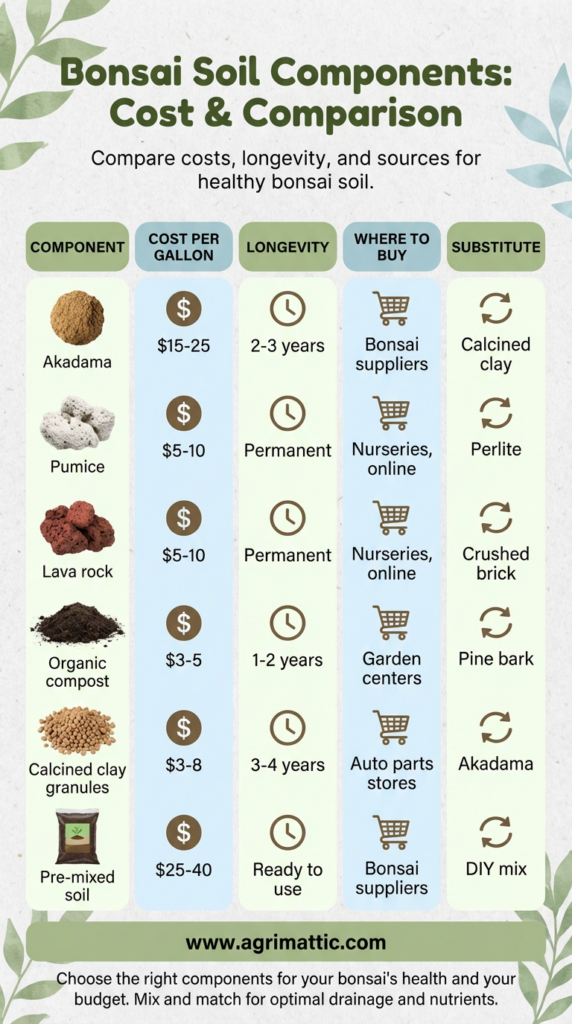
Soil Components Cost Comparison
| Component | Cost per Gallon | Longevity | Where to Buy | Substitute |
|---|---|---|---|---|
| Akadama | $15-25 | 2-3 years | Bonsai suppliers | Calcined clay |
| Pumice | $5-10 | Permanent | Nurseries, online | Perlite |
| Lava rock | $5-10 | Permanent | Nurseries, online | Crushed brick |
| Organic compost | $3-5 | 1-2 years | Garden centers | Pine bark |
| Calcined clay | $3-8 | 3-4 years | Auto parts stores | Akadama |
| Pre-mixed soil | $25-40 | Ready to use | Bonsai suppliers | DIY mix |
Soil and Watering: The Connection
Your soil choice directly affects how you water. Understanding this relationship is crucial.
Fast-Draining Soil = More Frequent Watering
Characteristics:
- High percentage of pumice/lava
- Water flows through quickly
- Dries out faster
Watering approach:
- Check soil twice daily in summer
- Water as soon as top feels dry
- May need to water 2x per day in heat
Best for:
- People who tend to overwater
- Humid climates
- Trees that hate wet roots (pines)
Water-Retaining Soil = Less Frequent Watering
Characteristics:
- High percentage of akadama/organic matter
- Holds moisture longer
- Dries out more slowly
Watering approach:
- Check soil once daily
- Let surface dry slightly between waterings
- Usually water once per day in summer
Best for:
- People who travel or forget to water
- Very hot, dry climates
- Trees that like constant moisture (willows)
The Balance
Most growers aim for soil that requires daily watering in summer but not multiple times per day. This provides enough moisture while ensuring good drainage and aeration.
Special Soil Considerations
For Acid-Loving Plants
Some plants need acidic soil:
- Azaleas
- Camellias
- Blueberries
- Rhododendrons
Special mix:
- Use Kanuma (acidic volcanic soil from Japan)
- Or add sulfur to regular mix
- Avoid alkaline components like limestone
For Succulent Bonsai
Jade, portulacaria, and other succulents need extremely fast drainage:
Mix recipe:
- 20% Akadama
- 40% Pumice
- 40% Lava rock
- 0% Organic matter
Why: Succulents store water in leaves/trunk and hate wet roots
For Shohin (Tiny) Bonsai
Very small trees (under 6 inches) in tiny pots need special consideration:
Adjustments:
- Use smaller particle size (1-3mm)
- More water retention (higher akadama percentage)
- Water more frequently (soil dries very fast)
Environmental Factors
Your climate affects what soil mix works best.
Hot, Dry Climate
Challenges:
- Soil dries extremely fast
- May need to water multiple times daily
- Trees can suffer from heat stress
Soil adjustments:
- Increase water-retaining components (60% akadama)
- Decrease drainage components (20% pumice, 20% lava)
- Consider adding 10% organic matter
- Use smaller particles for better retention
Cool, Humid Climate
Challenges:
- Soil stays wet longer
- Risk of fungal issues
- Less evaporation
Soil adjustments:
- Increase drainage components (40-50% pumice/lava)
- Decrease water-retaining components (40% akadama)
- Avoid organic matter or use very little (5%)
- Use larger particles for faster drainage
Indoor Growing
Challenges:
- Lower light = less water use
- Heating/AC creates dry air
- Less air circulation
Soil adjustments:
- Balance is key (standard mix usually works)
- May need humidity tray despite fast-draining soil
- Monitor closely – needs vary by season
Making Soil Work in Your Climate
Desert Climates (Hot and Dry)
Challenge: Soil dries extremely fast
Solution:
- Use 60% akadama for maximum water retention
- Consider smaller particle size (2-3mm)
- Add 10% organic matter
- Choose larger pots when possible
- Place trees in partial afternoon shade
- Water twice daily in peak summer
Tropical Climates (Hot and Humid)
Challenge: Constant moisture, risk of rot
Solution:
- Use 50% drainage materials (pumice/lava combined)
- Larger particle size (4-5mm)
- No organic matter or minimal (5%)
- Ensure excellent air circulation
- Be vigilant about fungal issues
- May need fungicide treatments
Temperate Climates (Four Seasons)
Challenge: Varying conditions throughout year
Solution:
- Standard all-purpose mix works well
- 50% akadama, 25% pumice, 25% lava
- Adjust watering frequency seasonally
- This is the “easiest” climate for bonsai
- Most bonsai resources assume this climate
Cold Climates (Long Winters)
Challenge: Frozen soil, root damage from freeze-thaw
Solution:
- Good drainage prevents ice damage
- Standard mix with slightly more pumice
- Protect roots in winter (bury pots, use protection)
- Ensure soil is moist (not wet) going into winter
- Don’t fertilize late in season
Frequently Asked Questions (FAQ)
1. Can I use regular potting soil for my bonsai?
No. Regular potting soil is not good for bonsai. It holds too much water, drains slowly, and blocks air to the roots. Bonsai pots are shallow, so roots can rot easily.
2. Why is bonsai soil so expensive?
Bonsai soil is expensive because it uses special materials like akadama, pumice, and lava rock. These materials are often imported, processed, and heavy to ship. Ready-made mixes cost more because they save time and effort.
3. How often should I change my bonsai soil?
Most bonsai need new soil every 2–3 years.
- Young trees: every 1–2 years
- Old trees: every 3–5 years
- Conifers: repot less often than deciduous trees
Soil breaks down with time and stops draining well.
4. Can I just buy pre-mixed bonsai soil instead of making my own?
Yes! Pre-mixed soil is an excellent choice, especially for beginners. It’s convenient, consistent, and takes the guesswork out of mixing proportions. Brands like Bonsai Jack and Superfly Bonsai make quality pre-mixed soils.
5. What’s the difference between akadama and regular clay?
Akadama is a special fired clay from Japan made into hard, porous grains. It holds water but still lets air and water drain well. Normal clay from the ground is bad for bonsai. It is fine, dense, and packs tight when wet, which harms roots.
6. My soil has white crusty stuff on top. What is it?
The white crust is salt buildup from fertilizer and hard water. It is common and usually not dangerous, but it shows too much salt.
What to do:
- Once a month, flush the soil with plain water
- Use rainwater if possible
- Use less fertilizer
- Repot with fresh soil when needed
- Remove the crusty top layer if it’s thick
7. Can I reuse old bonsai soil when repotting?
No. Always use fresh soil when repotting a bonsai. Old soil is broken down and does not drain or breathe well. It may also have old roots, pests, diseases, or salt buildup.
8. What’s the best bonsai soil for beginners?
For beginners, use ready-made bonsai soil or make a simple mix:
- 50% akadama (or fired clay)
- 25% pumice
- 25% lava rock
This mix works for most bonsai and is forgiving if you over- or under-water.
You can change the mix later as you gain more experience.
9. Do indoor and outdoor bonsai need different soil?
Indoor and outdoor bonsai use the same fast-draining soil, but indoor trees hold a bit more water (around 40–50% akadama) while outdoor trees need faster drainage. The key for all bonsai is good drainage, airflow, and proper water retention.
10. How do I know if my soil is draining properly?
To test drainage, water your bonsai well. Water should soak in within 5–10 seconds and drain from the bottom immediately. If it pools or drains slowly, the soil is too dense or old. If it runs through too fast without soaking, the particles may be too big or very dry. Good bonsai soil absorbs water quickly but also drains fast.
Learning Resources
Books: “The Complete Book of Bonsai” by Harry Tomlinson and “Modern Bonsai Practice” by Larry Morton cover soil science in detail.
Websites: Bonsai Empire (bonsaiempire.com) offers free courses on soil mixing, and Bonsai Nut (bonsainut.com) has active forums for discussions.
YouTube: Search “bonsai soil mixing” for visual demonstrations. Channels like Bonsai Mirai and Herons Bonsai provide excellent tutorials.
Local: Join a bonsai club in your area to learn soil recipes that work best in your specific climate.
Conclusion:
Bonsai soil is the foundation of your tree’s health. It must provide three things: water retention, fast drainage, and good aeration. Start with a simple mix of 50% akadama (or substitute), 25% pumice, and 25% lava rock. This works for most trees.
Never use regular potting soil – it stays too wet in shallow pots and will kill your tree. Invest in proper components or buy quality pre-mixed soil. The soil might look like rocks, but it’s actually one of your most important tools. Get this right, and everything else becomes easier!
Note: Particle sizes and proportions can be adjusted based on local availability of materials and specific tree requirements. Always observe your trees and adjust care accordingly.
Also Read: